


Raster images are often used in CAD workflows to reference scanned drawings, terrain photographs, or background images. Understanding how raster images work in LusoCAD helps you integrate them efficiently into your drawings without compromising performance or accuracy.
What is a Raster Image in CAD?
A raster image in CAD (Computer-Aided Design) is a digital image made up of a grid of pixels, where each pixel contains a specific colour value. Unlike vector objects, raster images do not possess geometric information.
Características das Imagens Raster
Pixel-based
As imagens raster são constituídas por pequenos quadrados denominados píxeis. pixels. Together, these pixels form the complete image.
Dependents of the Resolution
The quality of a raster image depends on its resolution, usually measured in pixels per inch (PPI). Higher resolution offers greater detail but increases file size and can affect performance.
Common File Formats
The most used raster formats in LusoCAD include:
- JPG / JPEG
- PNG
- Loss-making
- TIFF
These formats are ideal for photographs, scans, and visually complex images.
Using Raster Images in LusoCAD
Background References and Textures
Raster images can be attached as backgrounds or textures, providing visual context to the project.
Import of Scanned Drawings
Digitalised plans, manual sketches or documents can be imported and used as a reference for tracing or aligning entities.
Limitations
Raster images lose quality when enlarged and can become pixelated. For this reason, they are not suitable for designs that require frequent resizing or precise editing, unlike vector objects.
How to Attach Raster Images in LusoCAD
Utilise the command IMAGEATTACH to attach raster images (bi-level, 8-bit grayscale, 8-bit color, or 24-bit color) to the drawing. After attaching, the same image can be inserted multiple times, similar to a block.
It is also possible:
- Crop images
- Adjust brightness, contrast, fade and transparency

Steps for Attaching a Raster Image
- In the main menu, select Insert > Raster Image Reference
- Locate the image file and click Open
- In the dialog box Picture:
- Active Specify on screen for the Insertion point and Scale
- Define the angle of Rotation, if necessary
- Click on OK
- Specify the insertion point in the drawing
- Specify the scale factor
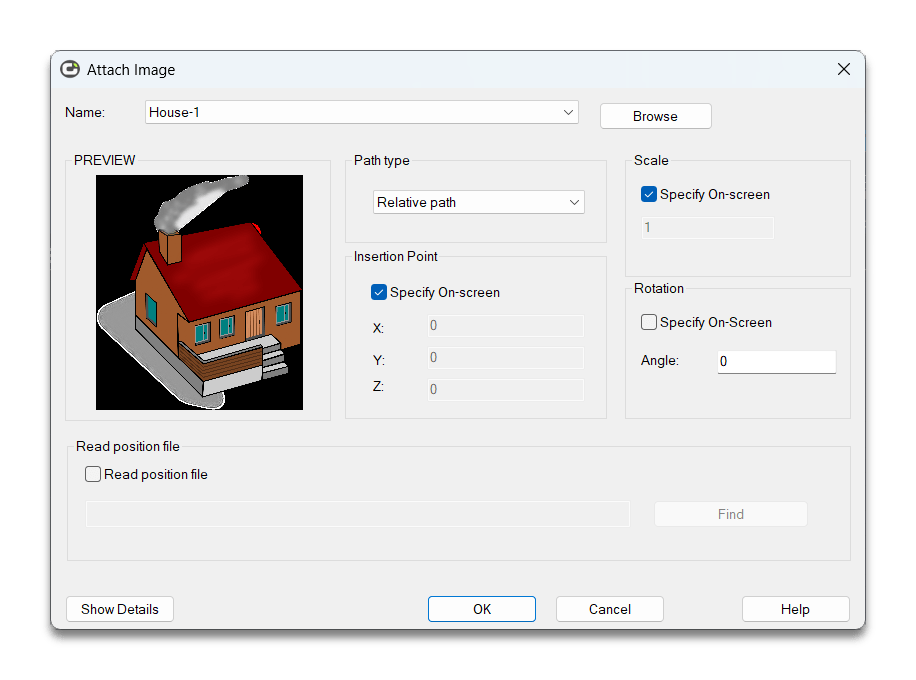
How to Scale Raster Images
It is possible to define the scale factor directly in the dialog box Picture.
If no scale is specified, the image is attached with its original dimensions.
- Scale factors are unitless by default
- The image is scaled proportionally according to the factor entered
How to Detach Raster Images
If a raster image is no longer needed, it can be removed from the drawing.
When removing an image:
- All instances, links and definitions are purged from the drawing
- The original image file on disk it is not affected
Presentation of Outlines (IMAGEFRAME Command)
It is possible to activate or deactivate image outlines in the current view.
Values
1– Display and print the image outlines0Hide contours on screen and print

To activate or deactivate outlines via the menu:
- Select Modify > Object > Image > Outline
- Choose one of the following options:
- Introduction 1 to show the outlines
- Introduction 0 to hide the outlines
How to Crop Raster Images
Raster images can be cropped with rectangular or polygonal boundaries.
Steps to Crop an Image
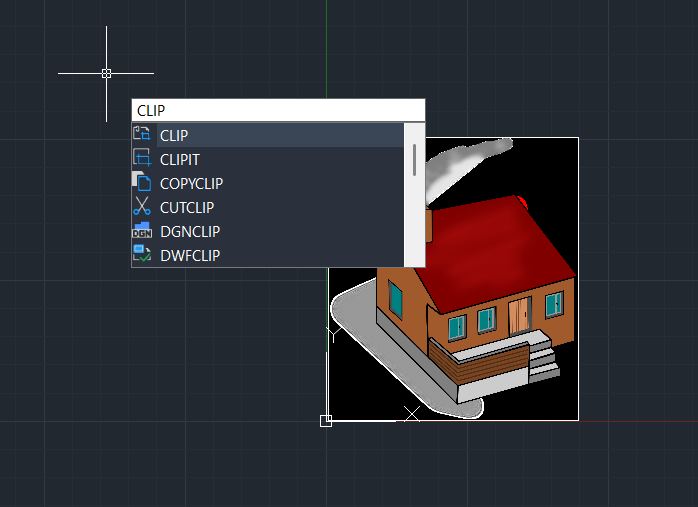
- Select Modify > Crop > Image or write CLIP
- Select the image to crop
- Introduction N New limit

Rectangular crop
- Define the first canto
- Opposite corner
- Only the area inside the rectangle remains visible
Polygonal Clipping
- Indicate the points of the polygon
- First Enter To conclude
- Only the area inside the polygon remains visible

Adjust Brightness, Contrast and Fade
Utilise the command Image Adjust to control:
- Shine
- Contrast
- Fading
These adjustments affect only the display and printing.
The original image file and other instances of the image are not changed.

Improving Performance in Raster Image Viewing
LusoCAD allows control of the display quality of raster images to improve performance.
- High Quality - Better image definition, slower visualisation
- Draft Quality – Faster viewing with less detail
The use of the mode Draft can significantly improve performance when working with large-dimension or a large number of raster images.

 English
  Portuguese
  Spanish